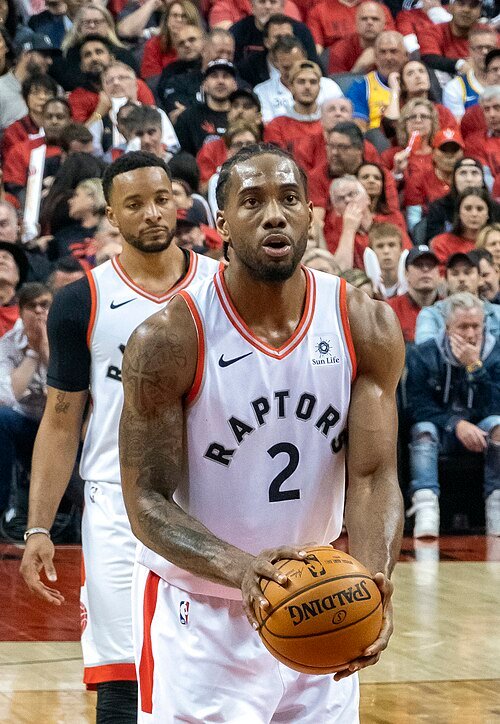
The Kawhi Leonard Misunderstanding
Modern sports culture rewards performance beyond the game.
Personality.
Interviews.
Social media presence.
But Kawhi Leonard became a superstar by rejecting almost all of it.
He rarely speaks publicly.
Avoids unnecessary attention.
Shows little emotional spectacle.
And yet:
Players fear him.
Teams depend on him.
Championships follow him.
That’s not accidental.
That’s strategic introversion.
Step 1: Let Skill Replace Personality
Most athletes market themselves through charisma.
Leonard did the opposite.
He built credibility through execution.
Research on expertise development shows elite performers achieve dominance through deliberate practice, repetition, and focused refinement, not personality alone (Ericsson et al., 1993).
Kawhi became known for:
- Defensive precision
- Mid-range efficiency
- Mechanical consistency
- Emotional composure under pressure
He didn’t try to become likable.
He became unavoidable.
Blueprint Principle #1
Build a skill so undeniable that personality becomes optional.
Step 2: Use Silence as Psychological Pressure
Leonard’s silence became part of his identity.
And silence creates uncertainty.
Research in interpersonal psychology suggests people naturally project assumptions onto emotionally restrained individuals, often perceiving them as more powerful or difficult to read (Ambady & Rosenthal, 1993).
Kawhi rarely explains himself.
Which means opponents, and even the media, must interpret him.
That creates mystique.
Blueprint Principle #2
The less predictable you are, the harder you are to control.
Step 3: Emotional Control Over Emotional Display
Basketball rewards emotional intensity.
But Leonard rarely reacts publicly.
No excessive celebrations.
No emotional outbursts.
No constant validation-seeking.
Research on emotional regulation shows that individuals who maintain composure under stress often make better high-pressure decisions and sustain performance longer (Gross, 1998).
Leonard doesn’t waste energy performing emotion.
He conserves it for execution.
Blueprint Principle #3
Emotional restraint increases strategic clarity.

Step 4: Weathering the Storm Through Selective Detachment
Kawhi’s career included:
- Major injuries
- Team transitions
- Media criticism
- Questions about leadership
Yet he continued winning.
Why?
Because he detached from narratives.
Research on self-determination theory suggests internally motivated individuals are more resilient under external pressure because their identity is less dependent on public approval (Deci & Ryan, 2000).
Leonard does not appear driven by popularity.
He appears driven by control.
Blueprint Principle #4
Detach from noise to protect long-term performance.
Step 5: Strategic Load Management
One of the most criticized aspects of Leonard’s career was “load management,” which is resting healthy players, particularly stars, to prevent injuries and manage fatigue.
But strategically, it extended his effectiveness.
While the culture glorified constant availability, Leonard prioritized sustainability.
Research on sports performance shows that recovery management significantly improves long-term elite performance and reduces performance decline under repetitive stress (Kellmann, 2010).
The public saw absence.
Leonard saw preservation.
Blueprint Principle #5
Protect your longevity, even when others misunderstand the strategy.
Sports culture celebrates loud leadership.
Kawhi Leonard proved something uncomfortable:
You do not need to dominate the room to dominate the outcome.
You can:
- Speak less
- Reveal less
- Market yourself less
And still become one of the most effective players in the world.
Because influence is not always expressive.
Sometimes it is structural.
The Strategic Introvert Blueprint
Reverse-engineering Kawhi Leonard’s rise reveals a repeatable formula:
- Replace attention-seeking with mastery
- Use silence strategically
- Conserve emotional energy
- Detach from external narratives
- Prioritize sustainability over optics
This is not passive introversion.
This is controlled power.
Kawhi Leonard did not become elite by becoming louder.
He became elite by becoming harder to disrupt.
And in a culture addicted to visibility, that may be the most powerful strategy of all.
–American Academy of Advanced Thinking & OpenAI
__________________________________________
References
Ambady, N., & Rosenthal, R. (1993). Half a minute: Predicting teacher evaluations from thin slices of nonverbal behavior and physical attractiveness. Journal of Personality and Social Psychology, 64(3), 431–441. https://doi.org/10.1037/0022-3514.64.3.431
Deci, E. L., & Ryan, R. M. (2000). The “what” and “why” of goal pursuits. Psychological Inquiry, 11(4), 227–268. https://doi.org/10.1207/S15327965PLI1104_01
Ericsson, K. A., Krampe, R. T., & Tesch-Römer, C. (1993). The role of deliberate practice in expert performance. Psychological Review, 100(3), 363–406.
Gross, J. J. (1998). The emerging field of emotion regulation. Review of General Psychology, 2(3), 271–299. https://doi.org/10.1037/1089-2680.2.3.271
Kellmann, M. (2010). Preventing overtraining in athletes in high-intensity sports and stress/recovery monitoring. Scandinavian Journal of Medicine & Science in Sports, 20(2), 95–102. https://doi.org/10.1111/j.1600-0838.2010.01192.x
Kohmura, Y., Suzuki, K., Someya, Y., Yamazaki, K., & Aoki, K. (2023). Effect of sports experiences on competition level and exercise habits in Japanese collegiate athletes. Journal of Human Sport and Exercise. https://doi.org/10.14198/jhse.2023.183.19
Images:
“1 kawhi leonard 2019 nba finals” by Chensiyuan is licensed under CC BY-SA 4.0.
“1 kawhi leonard 2019 (cropped)” by Chensiyuan is licensed under CC BY-SA 4.0.